Category Archives: Review

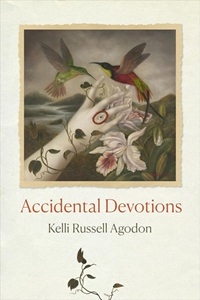
On Kelli Russell Agodon’s Accidental Devotions

Accidental Devotions
Kelli Russell Agodon
Copper Canyon Press, May 2026

Copper Canyon Press describes this book as a “defiant field guide to staying human.”

This 112-page collection of about 45 poems is arranged in four parts: “Scrolling for God,” “Rebel Angels,” “Cathedral of Clouds,” and “Unmistakable Prayer.”

The poems explore a poet’s quest for identity in a world where technology permeates every aspect of people’s lives. The poems are, at once, funny, deeply philosophical, and a deeply personal reflection on sexual identity. The poet uses humor to examine lived experiences.

What strikes me is how she weaves the ordinary technological phrases into something profound. For example, “Alexa, Why Am I Falling Apart.” In this poem, a simple act of asking Alexa mundane questions turns into asking her some serious ones. Alexa’s inane answers and struggles to respond make you chuckle, highlighting that technology, despite its help, can’t replace human connection, which is a comforting thought.

In “Hey Kel, It’s Em, I Called Because I Read Your Poem,” the act of leaving a sincere, heartfelt message becomes what I assume is a monologue from none other than Emily (Dickinson) offering advice to the poet Kelli.

“I know you say that you’re accidentally

 devoted, but what if you’re inadvertently

lustheavy?”

On the other end of this poet-to-poet dialogue, “We Are the Only Poets, and Everyone Else Is Prose,” the poet pays tribute to Emily Dickinson. “It’s impossible not to love you.” The poet feels so close to Emily that there’s “—barely a dash between us.”

Drawing inspiration from Dickinson, Rilke, and Millay, the “ghosts of cannon,” the poet has mastered their technical skills as well. Though technically precise, the poems feel conversational and familiar. Only when you step back do you realize their brilliance.

The ultimate poem of the collection, “Necessary Prayer,” is a nod to Emily Dickinson’s  “A Letter to the World.” A “lifetime of letters sent to / your mailbox” reminds us that every generation of poets draws from the previous and leaves a legacy for the next. Language is inadequate, but its power fosters hope and connection.

“Many ways we can still hold joy

We go on not healed but hopeful.”

A Gently Told Tale – Night Island by Mary Helen Specht

Photo Source

Night Island by Mary Helen Specht
Prairie Schooner Winter 2014 Issue Volume 88 Number 3

I read this gently told story about a week ago, and I can’t forget it. Who would have thought a National Geographic-asque account would turn into a subtle fable of man’s transgressions against the nature? A couple observes the mating rituals of the turtles by the beach, and the tone in the earlier part of the story is measured and research-erly,

“Billy straddled the animal’s rubbery back in order to measure her shell at the widest point and then her head. Isabella jotted down the numbers in a notebook.”

Just a couple of researchers doing their duty, but what the narrator observes in the end is heartbreaking. The tone of the narrator at the end is non-judgmental and stoic, but it delivers the necessary punch regardless. The subtle suggestion earlier in the story,

“[…]she liked to imagine her own belly full of babies and to wonder if—one day—they would look like her or like him.”

foreshadows the conclusion of the story. Yet another observation by the narrator,

“Billy’s eyes were trained on the turtle’s underbelly, and it was during these moments Isabella felt most alone; by his total concentration on the animal, he pressed his absence through her.”

hints at the discord between the characters and suggests that Isabella carries the burden of conscience, and she is attuned to the injustice they are about to inflict on the animal realm.

The story is available online, (at least for now): http://prairieschooner.unl.edu/excerpt/night-island