I plan to post one poem each day to honor National Poetry Month. Please comment below any thoughts about the poem of the day.
Pratibha
Here’s the day 1 offering.
On Being Brought from Africa to America By Phillis Wheatley
‘Twas mercy brought me from my Pagan land, Taught my benighted soul to understand That there’s a God, that there’s a Saviour too: Once I redemption neither sought nor knew. Some view our sable race with scornful eye, “Their colour is a diabolic die.” Remember, Christians, Negros, black as Cain, May be refin’d, and join th’ angelic train.
Dear Readers, It is my pleasure to present the revival issue of The Literary Nest. I had to take a prolonged break from publishing the journal. During that time, I wasn’t certain that I would ever be back. But as with any creative venture, inspiration strikes when you are sitting idly. I read some amazing metrical poetry and wanted you all to have a taste of it. Who knows, more people would be submitting metrical, formal poetry in addition to the free verse and prose poetry. I do hope you enjoy this issue. I am going back to the quarterly publishing schedule as before. The next issue will be the winter issue coming out mid-January. Please comment below on this issue. I look forward to engaging with the readers.
Thank you, dear readers, for your continuous support. The Literary Nest is back with a few changes, primarily in the publishing calendar and the submission processing. The poems will appear online as soon as they are accepted. The complete issue will be deemed published twice a year, most likely in January and July. I will let you know the details as I iron them out. Meanwhile, I look forward to reading your poems. I have missed that for the last few years when The Literary Nest was on hiatus. I welcome you with all my heart. — Pratibha
The Literary Nest journal will begin an indefinite hiatus beginning July 1, 2021. Hence all submissions will be closed as of June 28, and the summer issue will be released on June 30, 2021. After that, the blog will continue to be updated often with material from archives and new poetry-related posts.
Look at me with these nouns, mounting verbs,
these lines that somehow link together,
teetering on the verge.
I feel gangly and unmeasured trying to find a stance.
If only this language was more substantial.
If only I could make a life beyond this life,
one I didn’t grow bored of.
Well, night night. Tomorrow I’ll try again.
How many times does the confusion back me up
leaving me gut punched and empty.
How many times are my memories
like coals at the burn barrel’s bottom,
all shimmering with heat
making me think, with all the smoke
and flames, that something’s going on
but it’s so hard to tell.
At one point I thought the pressure was on
me trying to say what had been said before, only better.
Now, I’ve let myself off the hook
I just play, which is where creativity comes from anyway, right?
So, I’ll have some fun while the sun’s still up,
lace some laces, spray the plants,
just like the old days at the creek’s bluff
leaping in abandon, making my version of a swan dive.
***
Editor’s Note:
The narrator presents every poet’s conundrum when caught in a creative funk. Some “memories / like coals at the burn barrel’s bottom” sparkle and invite the poet to dive into them to discover something precious. What a poet to do if not just take a swan-dive?
***
Dale Cottingham has published poems and reviews of poetry collections in many journals. He is a Breadloafer, won the 2019 New Millennium Award for Poem of the Year, and is a finalist in the 2021 Great Midwest Poetry Contest.
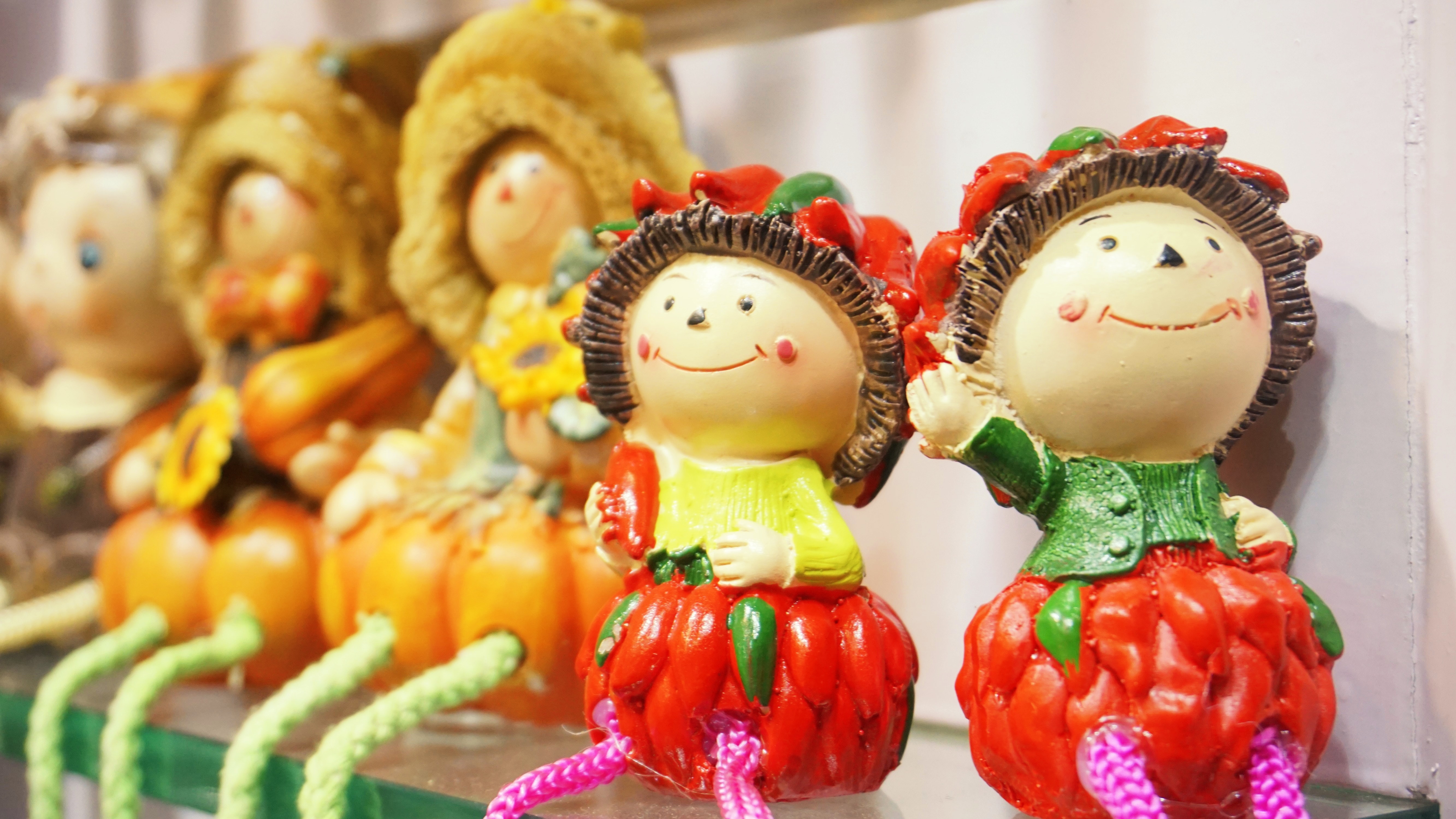
They called it her collection,
mementoes from all over the place.
I didn’t know where all over the place was
but the painted figures were so colourful
I thought it must be very different
to the grey drizzle of this place.
They told me they weren’t toys,
I was not even to touch them,
I could only look
as they stood
silently
in line
on their shelves.
Sometimes, though
when they pleaded with me
through their silence,
I gave them a little stroke,
I know it pleased them.
And once,
just once,
I took them down,
freed them from their cupboard,
from the straight lines of shelving
and allowed them to touch each other
to behave as they once did in their place.
That was the only time I heard them speak
and the colours poured from their voices
all over the place.
And now, it’s another time
and I’m in a different place
watching them still standing speechless.
Even their colours are muted with dust now
but I can hear their voices through the silence.
They’re pleading with me to free them again.
So I shall bid for Lot 53,
her collection.
***
Editor’s Note: The old lady’s captive collection of painted figurines come alive in the young child’s imagination, and the child breathes life into them. The idea of capturing the essence of the place one has traveled to in an object is a metaphor for something more significant. This poem tenderly shows us how an innocent child can set the world free.
*** Lynn White lives in north Wales. Her work is influenced by issues of social justice and events, places and people she has known or imagined. She is especially interested in exploring the boundaries of dream, fantasy and reality. She was shortlisted in the Theatre Cloud ‘War Poetry for Today’ competition and has been nominated for a Pushcart Prize and a Rhysling Award. Her poetry has appeared in many publications including: Apogee, Firewords, Capsule Stories, Gyroscope Review and So It Goes.
The house was an almost-ant hill.
The old woman seeking yogic powers
stayed on, hobbling around-
denouncing the world-
ulcerous wounds, slowly eating her body.
She sat on the creaking swing and sang in her lusty voice,
the ballad of the king, whose marriage was called off,
as the cook forgot to carry a fresh sprig of curry leaves.
She chased away robbers, yelling out to them- to come later
when she was gone, as everything would then be theirs.
The house, where the children had frolicked
while the brides sulked, as mice ran through the rafters,
where the dead calf lay buried under the turmeric plants
crumbled in response.
The cuckoo listened intently,
as her voice climbed
up the trunk of the tree
and soared unbound, free.
***
Editor’s Note: This poem captures the eccentricity and self-reliance of an old woman in a visual and evocative manner. Among several other visceral images, a single word, “ant-hill,” effectively captures the essence of the crumbling house.
***
Geetha Ravichandran lives in Mumbai. Writing is her first love. Her recent poems have appeared in Borderless, Setumag and in a couple of anthologies published by Hawakal.
Here’s one you haven’t heard,
he’d say to start each story—
and we hadn’t.
You could almost see him reach for the tale—
as if rummaging in the junk drawer
to retrieve it.
Sam worked at the Church Avenue Branch
of the library, until blindness
forced retirement.
He taught me to read
after my second grade teacher had declared
me hopeless.
He told stories to kids each Saturday morning
and taught English to adults three
nights a week.
I often subbed for him
as his cancer progressed—
I was happy at it.
Seventy years of smoking
had conspired to kill him.
As if the smoke
had found substance—a fat tabby
that slept soundly on his chest. I’d kill
for a Camel, he said with what passed
for a laugh—Got one?
I’d have given
him one if I still smoked, but I could see
his mood had changed. Here’s one
you haven’t heard, he said
one last time—in a half voice
I could barely understand.
When I was your age, I knew a storyteller—told tales that made you shiver.
“You have the gift.” he said.
I didn’t stay to watch him die.
That moonless night, the city
was dark as London in the blitz.
Here’s one you haven’t heard, I thought
taking a single baby step.
***
Editor’s Note:
What a lovely and gentle story of a storyteller and his protégée. Notice the linebreaks in stanzas 7-12. The regular length lines and complete sentences at both ends of the poem are interrupted by short lines with breath-stopping linebreaks in the middle, causing anticipation to build up.
***
Steve Deutsch lives in State College, PA. Some of his recent publications have or will appear in The Red Eft Review, Thimble, The Mark Review, Boston Literary Magazine, Rat’s Ass Review, RavensPerch, MacQueen’s, 8 Poems, Louisiana Lit, Burningword Literary Journal, Third Wednesday, and the Muddy River Poetry Review. Steve was nominated twice for the Pushcart Prize. His Chapbook, Perhaps You Can, was published in 2019 by Kelsay Press. His full length book, Persistence of Memory was published in 2020 by Kelsay. Steve’s third book of poetry, Going, Going, Gone, was just accepted for publication.




 from
from 

