Category Archives: blog

Donna Pucciani

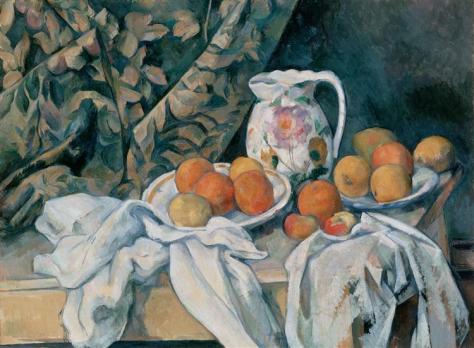
wiki-arts-still-life-with-curtain-and-flowered-pitcher-1895
public domain image from wikiart.org

Still Life

Still Life with Curtain and Flowered Jug

Paul Cezanne, c. 1898-99
The Hermitage, St. Petersburg

Painted in France, the fruits now rest
on a wall in Russia, no longer succulent
as when posing under the painter’s hand,
set with care on a wooden table
draped with a white tablecloth,
globes of green and red shining yellow
in the artificial light.

Plucked from a market in Paris,
they nudge each other on the canvas,
touching like the shoulders of museum-goers
staring at their luxurious community
of rotund joy, bowlfuls of delight.

Behind ceramic dishes, peach-filled
and radiant, a flowered water pitcher,
guarding all, but empty of purpose,
marks with scalloped edges the pretty line
where bright meets dark.

Beyond the furred juices of apricots
and the rumpled comforts of pale cloth,
a black curtain hangs, leaf-patterned
in dull and dying green, one corner
pulled back to reveal a flat, unutterable void.

Here’s the mystery of whatever lies beyond
the soft deliciousness of summer sweets:
the cold elegance of a pitcher, poppy-painted,
at the diagonal edge of empty. How easily
the unbleached linens fall to the foreground,
how pure and dire is the ebony backdrop
of an ordinary sunlit breakfast backing into
ultimate stillness.

***
Editor’s Note:
The poet uses the artwork to reveal the emptiness of life. Notice how the vibrant words with colors and pleasant sounds depict the beauty of the original scene and the gradual change of tone once the painting is hanging in the museum standing still. Notice the contrast between “the soft deliciousness of summer sweets” and “the cold elegance of a pitcher.”

***
Donna Pucciani, a Chicago-based writer, has published poetry worldwide in Shi Chao Poetry, Poetry Salzburg, ParisLitUp, Mediterranean Poetry, Meniscus, Voice and Verse, Gradiva, and other journals. Her seventh and most recent book of poetry is EDGES.

Erin Murphy

Taxonomies

1. Taxonomy of the Pre-Seatbelt Era

The summer we moved to Appalachia, gray cat
in one box, my baby brother in another. Me riding
shotgun, protected by my mother’s arm. My classmate
Sadie who went through a windshield. I pictured
her floating through a slow-motion spray of glass
stars. How did she stitch Sadie from Sarah? How did
she find herself behind the constellation of scars?

2. Taxonomy of Venom

Two girls Hula-hooping on the back patio
when a pair of young copperheads comes along.
My father raising the shovel above each one,
then waits for the mother. The clang of metal
on stone. The blood. The bodies tossed in weeds.
My friend, barefoot and stunned. My father’s own
sharp tongue that stings long after he leaves.

3. Taxonomy of 70s-Style Recycling

My single mother used margarine tubs
for Tupperware, served Kool Aid in jelly jars,
wrapped Pringles cans in tinfoil to transform
a kitchen chair into a birthday throne.
It wasn’t about sea turtles or the planet
but the thrill of thrift—sometime for nothing,
kids without a man, a magic trick.

4. Taxonomy of Taxonomies

From the Greek—taxis: order, nomos: science.
Rules for an unruly world. When my father
slipped into an unclassified black hole,I saved
babysitting money to paint my bedroom walls
yellow. I studied swatches: Sunny Veranda,
Forsythia, Pollen Powder, Gusto Gold,
each strip a family with the same undertones.

***
Editor’s Note:
The narrator attempts to order the unorderly life events in neat packages and does it quite effectively. This taxonomy of life itself is adorned with phrase-gems such as “constellation of scars,” “My father’s own/ sharp tongue that stings,” “kids without a man, a magic trick,” and “each strip a family with the same undertones.” The layered meanings of the phrases make this poem effective.

***
Erin Murphy’s latest book, Human Resources, is forthcoming from Salmon Poetry. Her work has appeared or is forthcoming in Southern Poetry Review, The Georgia Review, North American Review, Women’s Studies Quarterly, and elsewhere.Her awards include The Normal School Poetry Prize, the Dorothy Sargent Rosenberg Poetry Prize, and a Best of the Net award. She serves as Poetry Editor of The Summerset Review and is Professor of English at Penn State Altoona.

Praniti Gulyani

pexels-andrea-piacquadio-3769151
Photo by Andrea Piacquadio from Pexels

The Anatomy of Pain

you begin by teaching me –
about wafer-thin bones and agonized nerves
that have turned so blue, it hurts
to only look at them, and then you show me hearts
which have been frozen, stocked-up
caked with a sugary-silvery crust
of emotion, and brains encompassed
in a bubble, a jelly-like blob
of entangled, entwined, confused thought
you continue by teaching me –
about skulls, and you show me
the splintered skull of a newborn
patterned with bullet-holes
picked from the greyness and dustiness
which is, as they say
‘the legacy of war’
thereafter, we pass through the spirals
of patience, that branch into
resilience and courage, coated with
a cloak of dust, that falters
on the quivering shoulders of these paths
and covers the palms
and bruises the knees
of those, who can no longer sit atop
cold, metal chairs and bend and bow
their eyes dripping with tears
their lips dripping with prayer
on white bedsheet
or, at times, tucked into their folds
I find ailing pauses, picked from
that uncertain valley between life
and death, most gasping and some
reaching out, plucking bits of breath
molding it into thin strips, placing it
between clenched teeth, and
beneath shriveled tongues, while others
chose to let life slide
onto the carvings on their palm
and slowly, but surely
it skids away

and in the whimpering hues –
of the dewy, yellow light

with white and grey fingertips
tied together with
this tumor-like tightrope

I decipher
**********the anatomy
of pain

***
Editor’s Note:
I love how a narrator, perhaps a medical intern meanders through the halls of what seems to be a hospital, through a “valley between life and death,” and learns about pain in the most visceral way. So much is shown, and nothing is told, a hallmark of a good narrative.
***
Praniti Gulyani, a seventeen year old poet from India.

Victoria Melekian

pexels-markus-spiske-168866
Photo by Markus Spiske from Pexels

Some Call it Treasure

Junk toys my grandparents called them,
three bags, one for each boy, filled with stuff

my kids loved: stickers, red caps popped off
whipped cream cans, magnets, corks, rubbery

spiders and lizards, random board game tokens
all dumped across the floor, plastic that poked

bare feet, clogged the vacuum cleaner, spread
through my house. I wonder who had more fun—

little boys sorting through treasure or my grandparents
on the hunt for it all, strolling through Leisure World

looking for bits of sparkle the gardener’s broom missed,
stooping to grab a marble or tiny pencil,

crossing a parking lot and spotting a stray
Happy Meal toy, amassing piles of plastic surprises.

When Grandpa died, my sons gave
their great grandmother a box of dinosaurs,

striped dragons, and an orange frog—
a zoo of creatures to keep her company.

***
Editor’s Note: The playful sounds of this poem and the short phrases deftly portray children’s joy. The pace slows down when the grandparents enter the poem to indicate the mood change. The ending is touching.

***
Victoria Melekian lives in Carlsbad, California. Her stories and poems have been published in Mudfish, Literary Orphans, Atlanta Review, Valparaiso Fiction Review, Word Riot, and other anthologies. She’s been nominated for a Pushcart Prize and was a runner-up in the 2018 Bath Flash Fiction Novella-in-Flash Award. Her story “What I Don’t Tell Him” aired on NPR. She’s twice won a San Diego Book Award.

Raye Hendrix

119010073_10200461798040100_8790630455787904729_n
Image by Raye Hendrix.

For Ruth, After The Wildfires

for Ruth Bader Ginsburg / after Frank O’Hara

Tonight at the drug store I buy
as many condoms and emergency
contraceptives as I can carry,
and a candy bar from the stand at the front,
because isn’t all this sadness deserving
of something sweet?

Ruth, Ruth, Ruth: On the walk home
I whisper your name like a prayer,
smoke still hanging heavy
in the dampening evening air,
the rain announcing itself too little,
too late.

Two towns away the next two towns
have already disappeared to cinder—
the boot print of a careless god
stamped into the fir.

Ruth, Ruth: What are we going to do
without you? The air is still
too thick with ash to breathe.
***

Editor’s Note:  This poem effectively portrays the cognitive dissonance resulting from the dual tragedies. The desperation caused by the wildfires on the US West coast during last summer (and many summers before that) and the indifference of nature is shown theough a few short stanzas.
***

Raye Hendrix is a writer from Alabama. Her debut micro-chapbook, Fire Sermons, is forthcoming this Summer from Ghost City Press. Raye is the winner of the 2019 Keene Prize for Literature and Southern Indiana Review’s 2018 Patricia Aakhus Award. Her work has been featured on Poetry Daily and in 32 PoemsShenandoahCimarron ReviewPoetry NorthwestZone 3, and elsewhere. Raye is a PhD student at the University of Oregon studying Deafness, Disability, and Poetry.

Kathleen Goldblatt

Lullaby

She was making her way home—

she knew the road well yet
nothing was the same: the doctor had said there was
nothing he could do for that baby in her arms
so she turned around—

how much farther, her arms heavy now
how much farther, and no one could talk
when she arrived except a little girl
who played with the holy cards, who said,
that baby only smiles now.

Women wept and men did what men did
in the times when geese were fed in the yard.
Even after she was home, she kept walking
home with arms she could no longer feel
and heavy feet that shuffled.

When a baby flies past me—like lightning—
then disappears in the wind,
I remember her
and know that for a hundred years
weeping women don’t stop.

It’s then that I think she must still be walking,
singing her baby a lullaby, then another,
shushing her so that she may leave us all
to quiet—

***
Editor’s Note:
Everlasting grief and mother’s love lead to ultimate strength for the woman-kind and the world around her. I loved the tender tone of this poem that gently crawls into your heart.
***
Kathleen Goldblatt is a writer and Jungian analyst. She has been an advocate for social reform, most notably for the mentally ill. Kathleen is a training analyst with the CG Jung Institute of New England and the Inter-Regional Society of Jungian Analysts. She grew up in western New York State and resides in Newport, Rhode Island.

Earth Day 2021

pexels-lukas-rodriguez-5267339
Photo by Lukas Rodriguez from Pexels

A doomsday poem on this Earth Day

Finale
by Pratibha Kelapure with gratitude to Sara Teasdale

There will come crashing knowledge shortly
The eagles circling with wings courtly

And crickets in the bushes chirping at night
And giant redwoods in shining moonlight

Warblers will don their olive-green coat
Singing their songs on a high pitch note

And not one will know of your life, not one
Will care how well you lived in sun

Neither bird nor tree would be aware
If your kind vanished without heir

And sun’s blaze, when it shone at noon
Would hardly notice you gone soon

John Smith

pexels-flora-westbrook-1974381
Photo by Flora Westbrook from Pexels

Margaret’s Garden Hands

Margaret’s garden hands are dark,
mud-caked, bordered by lighter,
dried dirt, the pit of her palms
peeking through. They look like
blotchy prints of brown paint
a child pressed on a paper plate
or relief maps, the topography
of a life lived as close to earth
as a life can get this side of it.
But my sister’s hands aren’t prints
or raised maps. They’re cultivators,
as were our father’s, small
but strong and no strangers
to bare fistfuls of soil or fingernails
cracked and grouted; in fact,
first-hand familiar with the grip
and rip of weeds uprooted,
a clingy ball of earth, the weighty
shaking loose, and stubborn worms
that won’t let go, even with
part of them writhing on the
ground beneath. Years ago,
among unripe tomato plants
and the warm, licorice scent
of basil, sweet as memory itself,
Margaret’s hands were first
to touch our father lying
on his back in the garden,
life outgrown him. See how she
washes them now, one toughened
hand at a time, with the green
garden hose in the other.

***

Editor’s Note:
A simple action of washing muddy hands turns into a tender trip down the memory lane for the narrator and illustrates the continuity of life is and organic nature of life. The assonance and consonance keep the lines moving smoothly.
***
John Smith’s poetry has appeared in journals such as SmartishPace, Berfrois Journal, The Literary Review, and Spillway. His work has been set to music by composer, Tina Davidson, and commissioned by New Jersey AudubonHis book of poetry is titled Even That Indigo. John lives in Frenchtown, NJ with his wife, the calligrapher and henna artist, Catherine Lent.

World Poetry Day

In 1999,  UNESCO (the United Nations Educational, Scientific and Cultural Organization) designated March 21 is as World Poetry Day to celebrate ” linguistic diversity through poetic expression” and to increase “the opportunity for endangered languages to be heard.”

I take this opportunity to share beloved poems from the four languages, Sanskrit (Kalidasa), Hindi (Subhadra Kumari Chauhan), Marathi (Bahinabai Chaudhari), and Of course, English (Emily Dickinson). Except for the Sanskrit poet Kalidasa, I consider the other three poets as my foremothers in the sense that I love them, admire them, and draw inspiration from them.

  1. संस्क्रुत (Sanskrit)
    A verse from Meghdut (Cloud Messenger) by Kalidasa.

आषाढस्य प्रथमदिवसे मेघमाश्लिष्टसानुं।
वप्रक्रीडापरिणतगजप्रेक्षणीयं ददर्श।।

Loosely translated:
On the very first day of Aashadh, the cloud leans over
the cliff as if an elephant about to engage in amorous games

Aashads is the first month of Monsoon according to the Hindu Calendar.

  1. हिंदी (Hindi)

झाँसी की रानी (Queen of Jhansi) by सुभद्रा कुमारी चौहान (Subhadra Kumari Chauhan)

About The Queen of Jhansi.

A very good English Translation can be found here.

  1. मराठी (Marathi)

मन वढाय वढाय by बहिणाबाई चौधरी

मन वढाय वढाय, उभ्या पीकातलं ढोर ।
किती हाकला हाकला, फिरी येतं पिकांवर ।।

मन मोकाट मोकाट, त्याले ठायी ठायी वाटा ।
जशा वार्‍यानं चालल्या, पानावर्हल्यारे लाटा ।।

मन लहरी लहरी, त्याले हाती धरे कोन? ।
उंडारलं उंडारलं जसं वारा वाहादन ।।

मन जह्यरी जह्यरी, याचं न्यारं रे तंतर आरे ।
इचू साप बरा, त्याले उतारे मंतर ।।

मन पाखरू पाखरू, त्याची काय सांगू मात?।
आता व्हतं भुईवर, गेलं गेलं आभायात ।।

मन चप्पय चप्पय, त्याले नही जरा धीर ।
तठे व्हयीसनी ईज, आलं आलं धर्तीवर ।।

मन एवढं एवढं, जसा खाकसचा दाना ।
मन केवढं केवढं? आभायात बी मायेना ॥

देवा, कसं देलं मन आसं नही दुनियात ।
आसा कसा रे तू योगी काय तुझी करामत ॥

देवा, आसं कसं मन? आसं कसं रे घडलं ।
कुठे जागेपनी तूले असं सपनं पडलं ॥

Loose English Translation

The mind is a truant by Bahinabai Chaudhari

The mind is a truant like cattle in a field
You can drive it away, but it will always return

The mind is a stray; it wanders in all around
As the waves spiraling away in a breeze

The mind is temperamental; who can rein it in?
It’s as wild as the blowing wind

The mind is toxic; its ways are strange
A scorpion or snake is preferable; at least there are antidotes

The mind is a bird; how many of its exploits should I name?
One moment it’s on the ground; next, it has soared to the sky

The mind is too quick and so impatient
It’s lightning that strikes in a flash

The mind is small as a poppy seed
And how big is it? Even the sky can’t hold it

God, what is this unique mind you granted us?
What kind of Yogi are you? What is this marvel you created?

God, what is this mind? How did it arise?
What is this vision you saw while fully awake?

English
A Wounded Deer – Leaps Highest or as I like to say, “don’t let them see the blood.”

A Wounded Deer – Leaps Highest
By Emily Dickinson

A wounded deer – leaps highest
I’ve heard the hunter tell;
‘Tis but the ecstasy of death,
And then the brake is still.

The smitten rock that gushes,
The trampled steel that springs:
A cheek is always redder
Just where the hectic stings!

Mirth is mail of anguish,
In which its cautious arm
Lest anybody spy the blood
And, “you’re hurt” exclaim

Sparrows


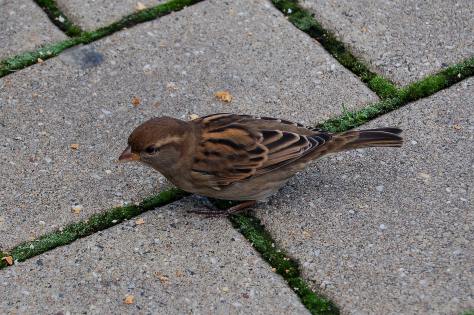
It’s the Spring Equinox today. Not only that, it happens to be World Sparrow Day.  It caught my attention because I have grown up with sparrows around me, listened to the nursery rhymes about sparrows, read children’s stories about sparrows. In Bombay (Mumbai now) sparrows were the only birds around, at least the ones I noticed. So I was disheartened to read that the sparrows are becoming extinct in Mumbai and the pigeons are taking over.  Nothing against pigeons, but sad about sparrows. Here are a few of my sparrow poems to amuse you.

The House Sparrow

Sparrow pauses on my window sill,
chirps a quick note, looks left, looks right, and
flies away leaving behind a half-eaten seed,
like an unfulfilled desire.

I see her every day bathing in dirt,
small brown wings flick around dust.
Just a small bird flying under clouds,
livening up my solitary afternoon.

My friends say, the male sparrow feeds the nestlings.
but, I see her at dusk, baby sparrows by her side,
pecking feverishly.
Mouth of the nestling, open, eager, waiting.
She holds a seed in her beak and drops it in.
A motherly act, if you ask me.

Kitty purrs behind me.
I pick her up and carry her away.

(First appeared in Mused – BellaOnline Literary Review, Fall 2014)


The Art of Mothering

Sparrow like a seamstress
Pleats feather upon feather
Shielding the nestlings
From the perils of cosmos
Not one of them will
Perish of nature’s vagaries
Before she can train them
The intricacies of flight
Nourish & coddle them only
Until their instincts stir
Until they soar to the sky
A Simple miracle
Letting go
The concept so elusive
To humans

(First appeared in Entropy, July 2020)


Low-Flying Bird

upon being shoved aside, the shock
doesn’t distress her, only the flock
she wants to belong, those who fly high
the wings untouched by human hands

being accustomed to the margins
she cozies up with the flowering hedge
to escape the constant jet engine whir
maybe a nosedive in lightning & thunder

flying solo isn’t a choice but a necessity
for the fallen bird, forsaken from the nest,
who never learns the secret of soaring
uncertain wings in the air flapping furiously

(First appeared in Entropy, July 2020)


Burning Woman

I set fire to the memories every summer
all through the fall and winter, word by word
I string the song of a savannah sparrow
staying close to the ground
foraging the buried syllables
seeping through the snow
and thaw them over my warm breath
those little things weigh heavy on my tongue
I am so tired of the harshness
grating on my ear
year after year,
I return to the ground and
polish the rough edges of words
the fierce polishing—the fleeting gleam
sometimes the sparks fly
singe my lashes, hair on fire
this merciless struggle
yet this sweet song of the sparrow

(First appeared in Entropy, July 2020)